
Our technology

How a platinum group metal becomes a working assembly.

Eight controlled stages, all under one roof — from PGM chemistry through to a tested assembly, a finished stack, and the metal recovered at end of life.

The short version

It starts with the chemistry, not the assembly.

Every product on this site — a catalyst for a refinery, a precursor for a semiconductor fab, a membrane electrode assembly for an electrolyser — begins at the same place: refined platinum group metal taken into solution and converted into a precursor of high and consistent purity.

Across every PGM, a single master chloride or salt is the gateway to an entire downstream family of compounds. Establishing that chemistry at source is what captures value at the highest-margin point of the chain.

What follows traces one of those routes end to end — the membrane electrode assembly, our most vertically integrated product. Everything about a PEM system's efficiency, durability and power density is decided in a stack of layers thinner than a business card, and it is decided by the chemistry upstream of it.

That is why we are vertically integrated. We do not buy in catalyst and coat it, or buy in coated membrane and assemble it. We control the chain from the precursor chemistry forward, because every step upstream constrains what is achievable downstream.

Anatomy

Inside a membrane electrode assembly.

An MEA is a symmetrical sandwich built around a proton exchange membrane. Hydrogen is oxidised at the anode catalyst layer; protons cross the membrane while electrons are forced around an external circuit; oxygen is reduced at the cathode. Run it in reverse with electricity in, and the same architecture splits water to make hydrogen.

The catalyst layers either side of the membrane are the performance-defining component — and they are where the platinum and iridium do their work.

  • Proton exchange membrane. Conducts protons, blocks electrons and gas crossover.
  • Catalyst layers. Platinum-based at the cathode, iridium-based for oxygen evolution in electrolysers.
  • Gas diffusion layers. Distribute reactant gas evenly and manage water.
  • Bipolar plates. Carry current and route the flow fields either side of the assembly.
Exploded cross-section diagram of a membrane electrode assembly, showing from top to bottom: bipolar plate, gas diffusion layer, cathode catalyst layer, proton exchange membrane, anode catalyst layer, gas diffusion layer and bipolar plate.
The layer stack of a PEM membrane electrode assembly.

The process

Eight stages, one facility.

These are our core capabilities. Each is a controlled process step with its own quality gates, and each feeds the next without leaving the building — ending where it began, with the metal recovered and refined.

PGM chemical processing & precursor synthesis

Refined platinum group metal is taken into solution and converted into the precursor salts and complexes that catalyst manufacture depends on. Purity and speciation here set the ceiling for everything that follows.

Precious metal catalyst manufacturing

Precursors are deposited onto support materials to produce supported platinum and iridium catalysts, with control over particle size, dispersion and metal loading — the levers that govern activity and durability.

Catalyst ink formulation

Catalyst, ionomer and solvent are combined into a stable, coatable ink. Rheology and dispersion state determine how the catalyst layer forms, so ink formulation is treated as a product in its own right, not a preparation step.

Catalyst-coated membrane production

Ink is applied directly to the proton exchange membrane on precision coating equipment, then dried under controlled conditions. Uniformity of loading across the active area is measured, not assumed.

Membrane electrode assembly fabrication

Coated membranes are combined with gas diffusion layers and sub-gaskets and consolidated into finished assemblies, sized and configured to the customer's stack design.

Electrochemical testing & quality control

Assemblies are characterised on in-house test stations for performance, and put through lifecycle and durability testing. Nothing ships on the basis of an incoming certificate alone.

Stack design & assembly

Assemblies are built into electrolyser and fuel cell stacks, with in-house CAD producing ready-for-manufacture designs and an automated test station handling quality control, at scales up to megawatt size.

PGM recovery, recycling & refining

Closed-loop recovery of platinum group metals from spent catalysts, process residues and end-of-life components. The route is planned to deploy IBC's SuperLig® Molecular Recognition Technology (MRT™), commercially proven in PGM refining since the mid-1990s and demonstrated on Isondo surrogate feeds separating iridium, platinum, ruthenium, rhodium and palladium at catalyst-grade purity. Recovered metal returns to the front of the chain, giving customers material security and a recoverable residual value. This stage is in development.

The chain

Where each stage sits.

Our position spans the middle of the beneficiation chain — the part that historically happened offshore — and closes it with a recovery loop.

Process flow diagram: PGM ore leads to refined metal, then precursor, catalyst, catalyst ink, coated membrane and MEA stack, with a recovery and recycling loop returning from the MEA stack to the precursor stage.

Why integration matters

What you get from a single-site chain.

Traceability

Every assembly traces back through its coating run, its ink batch, its catalyst lot and its precursor. When something moves, we can tell you why.

Faster iteration

Changing a catalyst loading or an ionomer ratio does not mean renegotiating with three suppliers. Development cycles compress to what the chemistry actually needs.

Supply security

The facility sits next to the world's dominant platinum reserves, inside a Special Economic Zone, with recovery capability closing the loop at end of life.

On the floor

Where it happens.

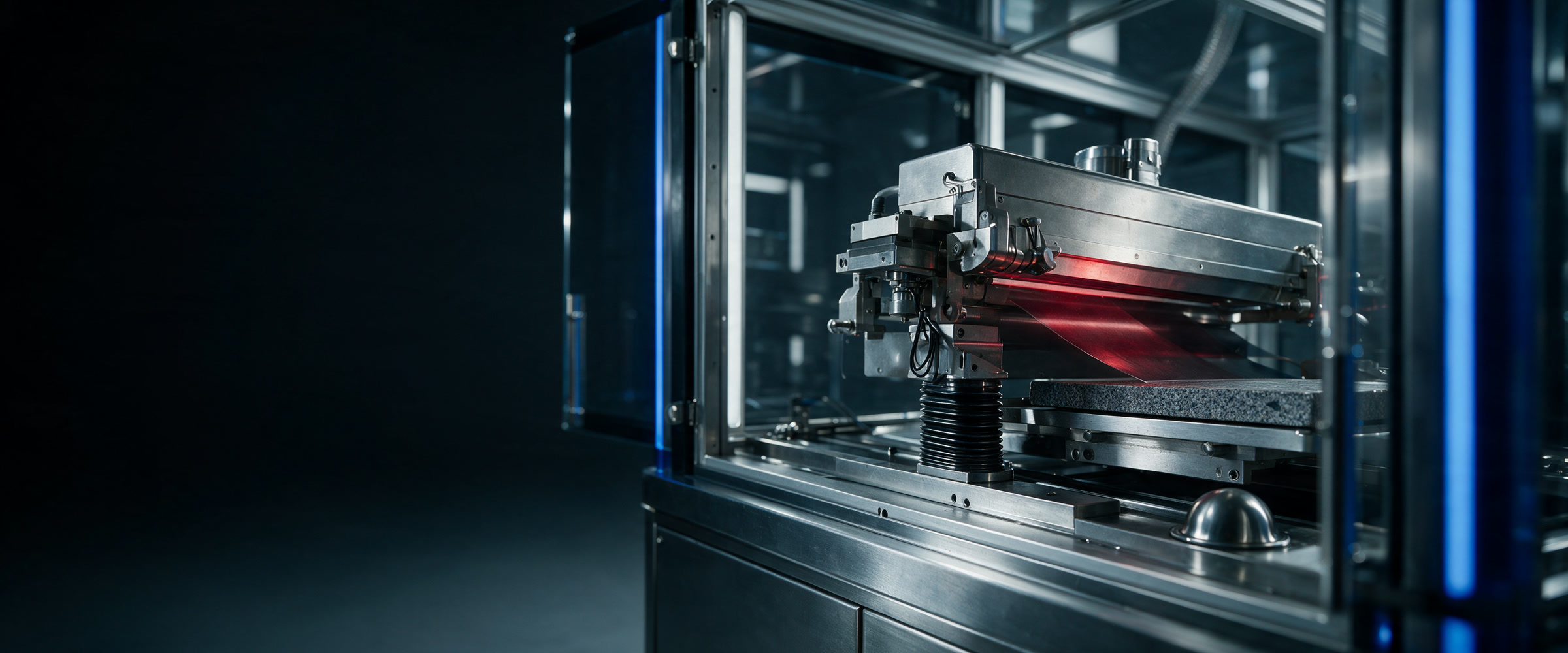
Precision coating head and granite bed of the catalyst-coated membrane line.
Precision coating head for catalyst-coated membranes.
Guarded automated production cell inside the Isondo manufacturing hall.
Guarded automated production cells.
Electrochemical test stations lined up in the Isondo facility.
Electrochemical test stations for MEA characterisation.

Bring us a specification.

Active area, target current density, duty cycle, operating window — send us what your stack needs and our technical team will come back on what is achievable.